 DefenseReview.com (DR): An online tactical technology and military defense technology magazine with particular focus on the latest and greatest tactical firearms news (tactical gun news), tactical gear news and tactical shooting news.


by David Crane
david@defensereview.com
All photos contained in this article were taken by U.S. Army Cpl. Benjamin Cossel and are the property of the U.S. Army and the Department of Defense (DoD). Click on photos below to view them full-size.
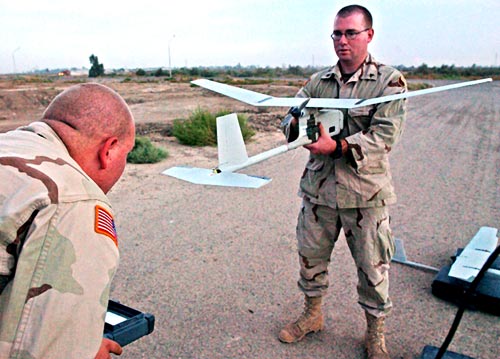 a number of force protection/tactical missions, including (but not limited to) IED (improvised explosive device) searches, reconnaissance patrols, and perimeter security (including base security). And, that’s not all. According to Sgt. Christopher Windle, Raven Team Leader for U.S. Army Task Force 1-7 (TF-17), the Raven SUAV "would be great for a FIST (Fire Support Team) to have, to be able to see a few more kilometers out there" for adjusting/aiming artillery fires. Sgt. Windle was trained as a Fire Support Team Chief prior to deployment with TF 1-7. Lt. Col. Kyle M. CcClelland, commander of TF 1-7 has been quoted as saying that the Raven "is critical in reducing the TTT (Troops to Task)". Because of this, it will most likely reduce U.S. infantry casualties, since human assets won’t have to be committed to those tasks that the Raven can handle within it’s operational envelope.
 The Raven SUAV only requires three soldiers to operate it, and doesn’t require an airfield to launch, since it’s throw-launched. It can be utilized for both daytime and night operations, anytime there’s a requirement for immediate, short range/low-cost real-time intelligence without risking human assets. Total situational awareness of the battlespace is one of the primary goals of the U.S. Army’s Future Force Warrior (FFW) and Future Combat Systems (FCS) programs, so the Raven unmanned aerial vehicle should fit right in with those programs and any other future infantry programs that spring up. The name of game for future infantry would appear to be maximum telepresence, where unmanned vehicles of all types–UAVs, UCAVs (Unmanned Combat Air Vehicle), UGVs (Unmanned Ground Vehicle), and UGCV (Unmanned Ground Combat Vehicle)–are wirelessly linked with pilots, ground troops/infantry personnel, and the military command structure/decision makers, so U.S. forces have superior information for tactical decision-making.
 RQ-11A Raven Small Unmanned Aerial Vehicle (SUAV) specs:
 Length: 1.1 m (3 ft 7 in)
Wingspan: 1.3 m (4 ft 3 in)
Weight: 1.9 kg (4.18 lb)
Speed: 95 km/h (60 mph)
Ceiling: 4500 m (15000 ft)
Range: 10 km (6.2 miles)
Endurance: 80 min
Propulsion: Aveox 27/26/7-AV electric motor
AeroVironment
Corporate Contact Info:Corporate Headquarters:
AeroVironment Corporation 825 S. Myrtle Dr. Monrovia, California 91016 Phone: 626-357-9983 Fax: 626-359-9628
AeroVironment Corporation 1610 S. Magnolia Dr. Monrovia, California 91016 Phone: 626-357-9983 Fax:626-359-9628
AeroVironment Corporation 4685-3H Industrial Street Simi Valley, California 93063 Phone: 805-581-2187 Fax: 805-581-4512
Articles:

